
Braces, clear aligners and retainers
Orthodontics moves teeth into positions where they meet correctly and share the work of chewing. Straight teeth are what you see; the bite is what keeps the result.
Here is what each appliance does, the records a case needs, how long it takes and how a quote is prepared. No prices: the cost depends on the case.
What orthodontics corrects, and at what age
When three or four teeth take the force twenty-eight should share, enamel flattens, restorations keep fracturing, and crowded surfaces a brush cannot reach turn into cavities. The usual reasons to treat:
- Crowding: more tooth than jaw, so teeth overlap and twist.
- Crossbite: upper teeth closing inside the lower. In a child the jaw can grow off-center, so it should not wait.
- Open bite, deep bite, overjet, spaces between the front teeth, and teeth that never came out.
A first check around age seven rarely means braces at seven. It catches what is easier to fix while the bones grow: a narrow upper jaw, a crossbite, a thumb habit, or space lost when a baby tooth came out early.
Teenagers are the classic window, with all permanent teeth in and growth still available; what limits the result then is hygiene, not biology. Adults move teeth at any age if bone and gums are healthy, only slower, and once growth is over a jaw mismatch is camouflaged or corrected with surgery.
Tooth movement: discomfort, timelines and risks
A tooth moves because bone dissolves ahead of it and forms behind it. More force is not faster: too much pressure stops that remodeling and risks the root. That is why visits are weeks apart.
Normal: tender teeth for two or three days after the appliance goes on and after each adjustment or new tray, worst at 24 to 48 hours; teeth that feel loose; the lip rubbing on a bracket the first weeks, which wax solves; a lisp for a few days with aligners. Not normal: a wire poking in, a loose bracket, a sore that will not heal, or pain still increasing after a week.
Most full cases run between about one and three years. An exact number before an examination is a guess: it depends on how far the teeth must travel, whether the bite relationship is corrected or only the alignment, age, whether extractions or surgery are in the plan, and cooperation with elastics and wear time. Missed appointments do not pause treatment; they extend it by more than the time missed.
Three risks are worth knowing before starting. The tip of a root can lose a little length (root resorption): usually minor, watched with X-rays, and not reversible. Gum can recede where a tooth is pushed outside the bone around it. And jaw joint discomfort is common while the bite is in transition; orthodontics neither reliably cures joint problems nor routinely causes them, but a joint that already clicks or hurts should be mentioned beforehand.
Records needed to plan a case
No case can be planned by looking into the mouth alone; half of what matters is under the gum. Four records are standard, taken before the plan is written.
- Panoramic X-ray. One wide image of both jaws: every tooth including those still inside the bone, the length and shape of the roots, the bone level, the wisdom teeth, and any infection that has to be treated first.
- Lateral head X-ray (cephalometric). A side view of the skull. Its measurements show how the jaws sit relative to each other and to the face, and how far forward or back the front teeth are tipped. It separates crooked teeth from a problem of jaw position: the difference between moving teeth and needing surgery.
- Photograph series. Intraoral photos record how the teeth meet from the front and each side; extraoral photos record the face and profile, at rest and smiling, and show how the smile sits in the face.
- Digital scan or study models. A copy of both arches. It measures how much space is missing and how the arches fit together, and it is what an aligner company needs to plan the case.
Preliminary treatment, extractions and surgery
Orthodontics is not the first appointment. Cavities are treated first, all of them: under a bracket a tooth is harder to reach and harder to see, and what would have been a small filling can turn into a root canal while it sits hidden for two years. Gums come next, because bone only remodels properly around a healthy attachment; with active inflammation, pushing a tooth speeds up bone loss instead, and with untreated periodontitis orthodontics can loosen teeth permanently. Cleanings continue every six months throughout.
Extractions. Only when there genuinely is not enough room. Space comes from widening the arch, from slimming the contacts between teeth by fractions of a millimeter, or from removing a tooth, usually a premolar. Pushing teeth beyond the bone that supports them causes gum recession and relapses more, so an extraction is sometimes the more conservative decision.
Orthognathic surgery. When the problem is the size or position of the jaws rather than the teeth, moving teeth can only camouflage it, and only so far. In an adult with a marked mismatch the correction is jaw surgery by a maxillofacial surgeon, with orthodontics before and after: braces line up each arch, surgery repositions the bone, orthodontics finishes the bite.
Types of braces
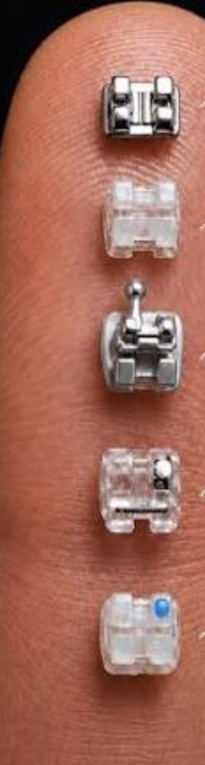
All braces work the same way: a piece is bonded to each tooth, a wire runs through them all, and the wire tries to return to its own shape, dragging the teeth with it. What changes is the material of that piece and how the wire is held.
1. Conventional metal
Steel, with the wire held by an elastic tie changed at every visit. The strongest and least expensive; they handle any movement, including severe crowding and impacted teeth, and they work whether or not the patient cooperates. Against them: the most visible, and the ties hold plaque and stain with coffee, soda and colored sauces.
2. Conventional esthetic (ceramic or sapphire)
The same design with the body in tooth-colored ceramic or translucent sapphire, so it blends with the enamel; the wire and ties still show. They cost more, ceramic is more brittle than steel and can fracture on removal or on something hard, clear ties tint over the weeks, and an upper ceramic bracket that the lower teeth close against can wear the opposing enamel.
3. Self-ligating metal
No ties: each bracket has a small door holding the wire. Less friction, nothing elastic collecting plaque, and visits can be spaced further apart, which matters to someone who travels or crosses the border. Against them: more expensive, bulkier against the lip, a door that can jam or break, and spacing visits out does not by itself end the whole treatment sooner.
4. Self-ligating esthetic
The same mechanism in a tooth-colored material: discreet, with no ties to stain between visits. The most expensive braces here, with a clip more delicate than the metal version, and some designs still show a metal part.
5. Champagne finish (Iconix)
Metal braces with a champagne-toned finish instead of steel gray; this office uses the Iconix brand. They keep the strength and full range of movement of metal, and the softer tone is less obvious against enamel and skin. Said honestly: they do not disappear the way ceramic does, the wire and ties still show, and they cost more than conventional metal.
Clear aligners
Aligners are thin clear trays, each slightly different from the last, each moving a few teeth a small amount. They are planned from the scan, the photographs and the X-rays: the path is laid out on screen step by step, and the trays are made from that plan.
The patient's part is 20 to 22 hours a day, out only to eat and brush; below that the plan stops matching the mouth. Because smooth plastic slides off a smooth tooth, small tooth-colored bumps of composite (attachments) are bonded to certain teeth for the tray to grip, and polished off at the end. Refinements are extra trays made near the end from a new scan, because teeth rarely track a plan perfectly.
This office works with Aliwell, which manufactures the trays and sets the package according to the difficulty of the case. Invisalign is also available, and the distinction matters: the office does not present itself as a certified Invisalign provider. Treatment with Invisalign is carried out by a certified orthodontist who comes to the office to perform it.
Aligners are a poor choice for anyone who already knows they will not wear them, and some movements remain more predictable with braces: large rotations of canines and premolars, moving a root bodily a long way, and bringing down an impacted tooth.
Aligner packages and how the cost is set
Aliwell works in packages, and the package is decided by how difficult the case is. All three include unlimited setups, meaning the digital plan can be redone as many times as the case needs, and replacement aligners at no cost.
| Package | What it is for | Aligners | On top of that |
|---|---|---|---|
| Social Fix | Relapse and simple movements | Unlimited for 12 months | Both arches or a single arch |
| Performance | Intermediate and complex cases | Unlimited for 24 months | DentalMonitoring at no extra cost |
| Xpert | Maximum complexity, no limits | Unlimited for 60 months | DentalMonitoring at no extra cost, two NX1 retainers |
Social Fix has defined qualifiers: movements from 4 to 4, the front segment between the two premolars; space under 4 mm; crowding under 4 mm; midline under 1 mm; intrusion under 1 mm. Its scope reaches an anteroposterior correction of the incisors of less than 2 mm, and it does not include intermaxillary mechanics, the work done with elastics connecting the upper arch to the lower one.
Performance covers Class I, II and III malocclusions, open bite, deep bite, spaces, intermaxillary mechanics, dental protrusion, expansion, skeletal anchorage, distalization and severe crowding. Xpert covers any malocclusion resolved with maxillofacial surgery, with dental extractions, with mixed dentition in two phases, or with highly complex movements such as moving back teeth forward or bringing in impacted teeth. DentalMonitoring is remote follow-up: the patient scans the mouth with a phone and progress is reviewed without coming in.
The cost of an aligner treatment is determined by the package the case requires. The records are taken, sent to the aligner company, and the company indicates which package corresponds. Only then is the quote given, in writing. That is why there is no list price: a relapse case and a surgical case do not cost the same. With braces, the cost depends on the appliance and the estimated length of treatment, and is also quoted after the examination.
Hygiene during treatment
With braces, plaque left against enamel for months pulls minerals out of it and leaves a chalky white spot around where the bracket sat: the beginning of a cavity, permanent, and visible exactly on the day the braces come off.
- Brush after every meal, angling above and below each bracket, not only across the front.
- Use an interdental brush, the small bottle-brush kind, to get under the wire.
- Floss with a threader, or use a water flosser, which is easier to keep up.
- Avoid what breaks brackets: ice, hard candy, nuts, whole apples, corn on the cob and anything sticky.
With aligners, hygiene is easier because the trays come out. The traps are different: drinking anything but water with them in keeps sugar and acid pressed against the enamel, and brushing before putting them back is not optional for the same reason. The trays are rinsed and brushed gently with cold water; hot water deforms them.
Retainers and the retention phase
The day the appliance comes off is not the end. Teeth have memory: the fibers around each root and the newly remodeled bone pull toward the old position, and for the first months the teeth are loose. That tendency is called relapse, and skipping retainers is the most common reason people pay for orthodontics twice.
Relapse never stops entirely. It is strongest in the first year, but teeth drift slowly for life, with or without treatment, so retention has no end date: the schedule gets lighter over the years, never zero.
A fixed retainer is a thin wire bonded behind the front teeth, usually the lower ones. It cannot be forgotten, but floss has to go under it, and it can come unglued unnoticed, so it is checked at every cleaning. A removable retainer is a clear tray or a plate with a wire, easy to clean and easy to stop wearing: full-time right after treatment, then nights only, then a few nights a week indefinitely.
A retainer that feels tight means the teeth have started moving: wear it more, not less. If it no longer fits, it must not be forced.
Frequently asked questions
How much do braces or aligners cost?
No prices are published: a number given before an examination is a guess. With aligners the cost follows the package the company assigns after reviewing the records; with braces it depends on the appliance and the estimated length. The quote comes in writing.
Do aligners work as well as braces?
In a cooperative patient, far more than they used to, including complex cases under the right package. But braces work whether or not the patient feels like it; aligners only at 20 to 22 hours a day.
Does it hurt?
Soreness, not sharp pain: tender teeth for two or three days after each adjustment or new tray. Soft food and a common pain reliever cover it, and wax handles a bracket rubbing the cheek.
What happens if I stop wearing my retainer?
They start moving back, within weeks during the first year, and the lower front teeth usually crowd first. If the retainer still goes in, wearing it again can hold the position. If it no longer fits, significant movement means another round of orthodontics.
Can I treat in Tijuana while living in the United States?
The office is five minutes from the San Ysidro crossing. Conventional braces need a visit every four to six weeks; self-ligating braces allow more spacing, and aligners travel best. U.S. PPO plans are accepted on a reimbursement basis.
This guide is general information written by the practice. It is not a diagnosis: what is right for your mouth can only be decided after an examination and X-rays.
Related topics
Children's dentistry
When to bring your child in, why baby teeth matter, how bottle cavities start, and what fluoride, sealants and baby crowns actually do.
Read the guideGrinding & jaw pain
Why you grind or clench, the signs a dentist reads in your mouth, what a night guard really does, and when jaw clicking needs treatment.
Read the guideWhitening & veneers
Why teeth darken, how whitening really works, why charcoal paste does not, and when veneers are worth the tooth structure they cost.
Read the guideSchedule your appointment with Dra. Itzel Gallegos
Send a WhatsApp message with your question, or a photo of the tooth that is bothering you. The answer comes from the practice, not a call center.