Your U.S. PPO plan, used in Mexico
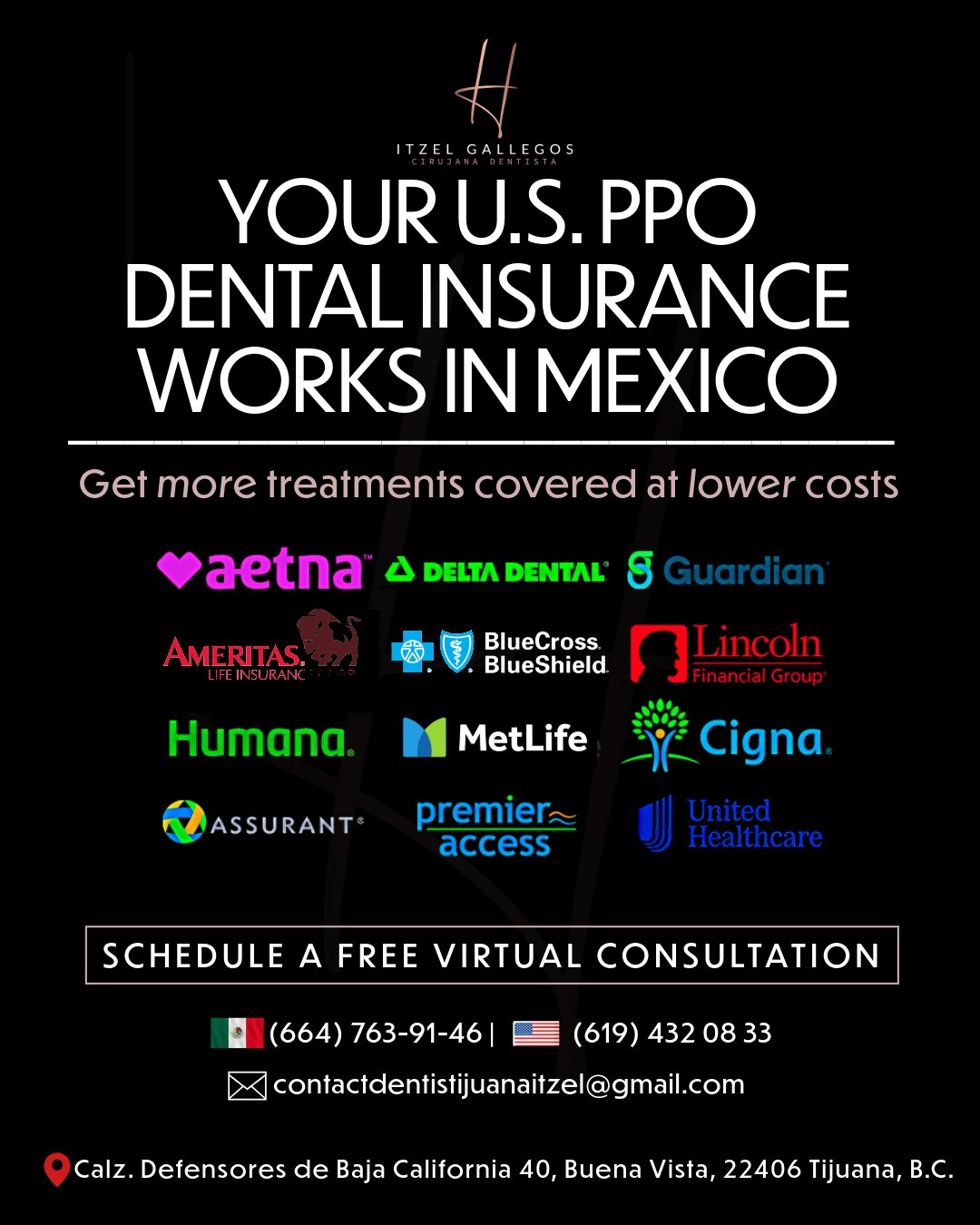
Most U.S. PPO dental plans reimburse out-of-network care, and treatment received in Mexico falls under that provision. The full procedure is set out here.
Check your insurance before you travel
It takes less than a minute. With these details the practice confirms what your plan covers and what you would pay, before you schedule the trip.
Plans filed here
 Aetna
 Delta Dental
 Guardian
 Ameritas
 BlueCross BlueShield
 Lincoln Financial
 Humana
 MetLife
 Cigna
 Assurant
 Premier Access
 United Healthcare
and many more PPO plans
Information required
A photo of your insurance card with the group or policy number visible, your date of birth, and the name of your insurer.
Eligibility verification
Before your visit, so you know what your plan covers instead of finding out after the drive.
Treatment and payment
Cash, card, transfer, Zelle or a payment link. Every procedure is recorded with its code and its tooth. What you pay at this point depends on which of the two arrangements your plan uses — you will already know which before you arrive.
Claim submission
With the codes, the X-rays and the notes the insurer needs. If they ask for more documentation, that is handled here.
Insurer payment
On most plans the check goes to you, at your U.S. address, usually in about a month. On plans that pay providers directly, it comes to the practice instead and you were charged less up front. Your policy decides which.
One thing worth knowing: a treatment plan is a recommendation, not a bill. You owe only what is actually done, and insurance coverage does not change that.
Example: $2,000 of coverage applied in each country
- 1 cleaning
- 1 root canal
- 1 crown
and the maximum is gone
- 1 cleaning
- 2 root canals
- 2 crowns
- 2 fillings
within the same amount
Approximate, using the reference prices on this site. A lower cost per procedure means the same annual maximum covers more treatment. That is the whole of it. Your own plan sets the percentage and the maximum.
How U.S. dental insurance works
Most of the confusion about using a U.S. plan in Mexico comes down to four or five words nobody ever explains. These are the ones that decide what you get back.
Types of dental plan
This is the question that matters most, and it is not the same as who sold it to you. One company sells plans that behave completely differently.
- PPO — the one that works here. A PPO lets you see any dentist and reimburses a percentage even when that dentist is outside its network. A dentist in Mexico is simply out of network. It is the most common type of employer dental plan in the United States.
- DHMO / DMO — the one that does not. A DHMO pays only if you go to a dentist inside its network, with no reimbursement outside it. If your card says DHMO, DMO or DeltaCare, treatment here is out of pocket.
- Discount plan — not insurance at all. It gets you a reduced rate at participating dentists and reimburses nothing. Worth knowing before you count on it.
- Indemnity — less common now, but it pays a set amount per procedure wherever you go, which makes it straightforward to use abroad.
Terms that determine your reimbursement
- Annual maximum
- The most the plan pays in a calendar year, no matter how much treatment you need. Commonly $1,000 to $2,500. It resets every January, and whatever you did not use is normally gone.
- Deductible
- What you pay before the plan starts paying. Often $50 to $100 a year, and usually waived on cleanings and check-ups.
- Coinsurance
- The percentage the plan reimburses, which changes by category. The classic split is 100% preventive (cleanings, X-rays), 80% basic (fillings, simple extractions) and 50% major (crowns, root canals, dentures). Implants and orthodontics usually sit in their own category, or are not covered at all.
- Allowed amount (UCR)
- What the insurer considers a reasonable fee for a procedure in your area. It reimburses its percentage of that figure, not of what you paid. That usually works in your favor here: the allowed amount for a crown in California is often higher than the full fee charged in Tijuana.
- Waiting period
- How long you must hold the plan before major work is covered, often six to twelve months. Common on individual plans, rare on employer plans. Check it before you book surgery.
Two clauses that catch people out. The missing tooth clause means many plans will not pay to replace a tooth that was already missing when the policy started. Coordination of benefits means that if two plans cover you, the second pays only what the first did not — not the same amount twice.
Out-of-network care: what it means in Mexico
A PPO network is a list of dentists who agreed to the insurer's fee schedule. Every dentist not on that list is out of network, whether the practice is two blocks away in San Diego or five minutes past the San Ysidro crossing. The plan does not sort by country. It sorts by whether the dentist signed a contract with it. We report procedures with the same ADA codes used in the United States — D1110 for a cleaning, D2740 for a zirconia crown — which is what lets the claim process normally.
PPO plans this practice files claims for
With any of these, your benefits are verified before your visit, and the claim is prepared and submitted from here. What matters is the plan type on your card, not just the company name. The notes flag where that difference bites.
-
AetnaSells both PPO and DMO plans. The PPO reimburses out-of-network care; the DMO generally does not.
-
Delta DentalDelta Dental PPO reimburses out of network. DeltaCare USA is a DHMO and generally does not. Check which one your card says.
-
GuardianPPO plans usually sold through employers. Some designs let part of the annual maximum roll over.
-
AmeritasPPO dental often bundled with vision. Individual plans commonly carry waiting periods for major work.
-
BlueCross BlueShieldA federation of independent state plans, so benefits and out-of-network rules vary considerably by state.
-
Lincoln FinancialPPO dental sold through employers. Coverage tiers follow the usual preventive, basic and major split.
-
HumanaSells both PPO and discount-style dental plans. A discount plan is not insurance and does not reimburse.
-
MetLifePPO dental widely used by employers and by federal employees. Out-of-network reimbursement is standard on the PPO.
-
CignaSells PPO and DHMO plans. The PPO reimburses out of network; the DHMO requires an in-network dentist.
-
AssurantDental benefits sold individually and through employers. Individual plans often have waiting periods.
-
Premier AccessA California-based dental plan. Confirm whether your product is the PPO or a managed-care plan.
-
United HealthcarePPO dental sold on its own and bundled with medical coverage.
And many other PPO plans. If your insurer is not on this list, send the card anyway: most PPO plans work the same way, and checking costs nothing. This practice is not affiliated with, endorsed by or contracted with any of these companies; the names appear only to show which plans are filed here.
Treatments usually excluded
Saying this upfront saves disappointment. Purely cosmetic work, such as whitening and veneers placed for appearance, is almost never covered. Some plans cover implants; many exclude them. Adult orthodontics is often excluded even when it is covered for children, and where it is covered it usually carries its own separate lifetime maximum. None of that changes what treatment costs here. It changes how much of it your plan gives back.
What it costs here and what it costs in the United States
Mark the treatments you were told you need and the calculator adds up both estimates. The ranges are the ones in this practice’s price comparison; implants, orthodontics and full-arch work are quoted case by case.
Treatments
Comparison
The figures are reference ranges in dollars, not a quote. The final estimate is given in writing after the clinical examination.
Common insurance questions
Which plans do you work with?
PPO plans from U.S. insurers: Delta, Cigna, MetLife, Aetna, Guardian and others. HMO and DHMO plans generally do not reimburse care outside their network, so they usually cannot be used here. Send your card and you are told what yours actually allows, before you drive down.
Do I pay, or does the insurance pay the practice?
There are two ways this can go, and your policy decides which one, not the practice. On most plans you pay for the treatment and the insurer reimburses you — a check to your U.S. address, usually in about a month. On other plans the insurer pays the practice directly; with those, some patients pay nothing out of pocket and others pay only their deductible or their share. Which one applies to you is established when your benefits are verified, before your visit.
What is needed from me?
A photo of your insurance card with the group or policy number readable, your date of birth as it appears on the policy, and the name of your insurer. That is enough to verify eligibility.
Are X-rays included?
The exam includes X-rays of the teeth that are bothering you, not a full series. A complete set is a separate charge, and it is usually what an insurer asks for when it wants to review a case. You are told if yours does.
Is there a fee for handling the claim?
Yes. Treatment billed through a U.S. insurance plan carries an administrative charge that covers verification, coding and filing. You see it in your written plan, never as a surprise at the end.
Schedule your appointment with Dra. Itzel Gallegos
Send a WhatsApp message with your question, or a photo of the tooth that is bothering you. The answer comes from the practice, not a call center.