
Root canal treatment and retreatment
A root canal has a bad reputation it no longer deserves. It saves a tooth when the nerve inside is inflamed or already dead, and the appointment is usually less unpleasant than the toothache that brought the patient in. This guide covers the first treatment, and what is done when a treated tooth gives trouble again.
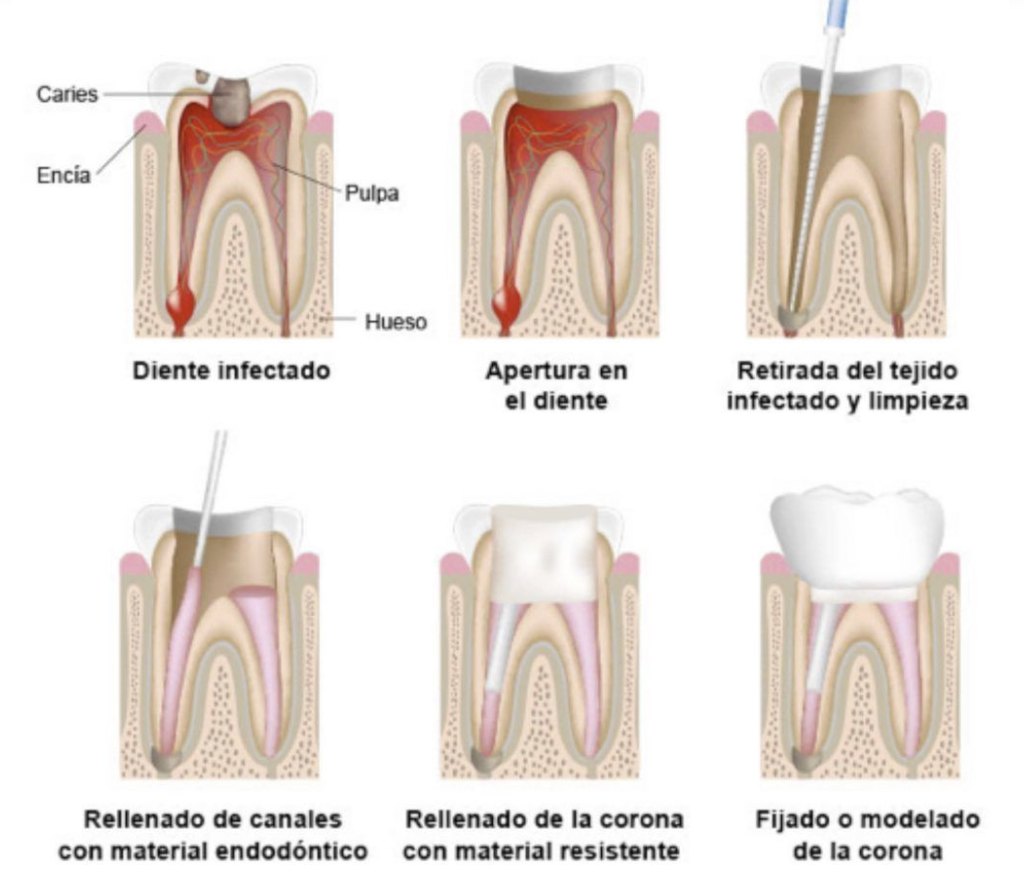
What a root canal is and when it is indicated
Every tooth has a hollow space in the middle, running from the crown down through each root. It holds the pulp, what patients call the nerve. The pulp does not feed the tooth: a ligament and bone hold it in place, so a tooth without pulp still chews for years. What it loses is the alarm that reports heat and cold, and it slowly becomes more brittle.
A root canal removes that pulp once it can no longer recover, disinfects the space and seals it. The pulp sits in a hard box with no room to swell, so past a certain point the choice is the pulp or the tooth. The usual causes:
- Deep decay that reached the nerve, by far the most common.
- A crack or fracture that exposes the pulp.
- A blow to a front tooth, sometimes years earlier; it can look intact with a dead nerve inside.
- Heavy wear, from grinding or acid, that leaves the pulp close to the surface.
- Repeated work on the same tooth.
A deep cavity does not automatically mean a root canal: if the pulp is only irritated, a filling and a few weeks of watching can be enough. The signs that it is not:
- Pain that starts on its own, wakes you at night, or worsens when lying down.
- Pain to heat that eases with cold, which usually means the pulp is dying.
- Pain that lingers for minutes, not the two seconds of normal sensitivity.
- Pain on biting, a bump on the gum, or a tooth turning gray or dark.
Most of these can wait for a normal appointment. What cannot wait is swelling spreading into the cheek, jaw or neck, with fever or trouble swallowing.
Procedure, number of appointments and recovery
The idea is simple: clean out the inside of the tooth, disinfect it, and seal it.
- Anesthesia. An inflamed tooth is harder to numb, so a second dose is sometimes needed. Nobody should start while the patient can still feel it.
- Rubber dam isolation. A rubber sheet clipped around the tooth keeps saliva and its bacteria out of the canal.
- Access, a small opening to reach the pulp chamber.
- Cleaning and shaping. Fine flexible files remove the pulp and give each canal a smooth, tapered shape. Canals curve and branch, and each one is measured so cleaning stops at the tip.
- Irrigation, a disinfecting solution flushed between files, which reaches side branches no instrument can enter.
- Filling, with gutta-percha, a rubber-like material, plus a sealer.
- Sealing the top, because a filled canal under a leaking temporary gets reinfected from above.
Most teeth are finished in one or two appointments. It takes more when a large infection needs medication inside the tooth between visits, when canals are very curved or calcified, when a molar has four canals instead of three, or when the case is a retreatment.
What hurts is the infection, not the treatment. With good anesthesia the procedure feels like a large filling: pressure, vibration and a tired jaw. For two or three days afterward the tooth is tender to bite on, because the ligament around the root was irritated.
Call the office if pain increases after the third or fourth day, swelling or fever appears, the temporary comes out or feels high, or a bump returns on the gum even without pain.
Restoration after a root canal
This is the part that gets skipped, and it decides whether the tooth lasts. Two things weaken a treated tooth: whatever caused the problem, since decay or a fracture that reached the pulp has already taken a large part of the tooth, and the access opening, which removes structure from the middle of the chewing surface, where the tooth is braced against flexing.
Hollowed out, and no longer able to feel that it is overloaded, a molar flexes under normal chewing until a wall splits. When that split runs down into the root, the tooth cannot be repaired. Vertical root fracture is the most common way a well-treated tooth is still lost, and it is almost always a tooth that never got its crown.
For molars and premolars that means a crown, or at least a restoration covering the cusps, within weeks and not months. Usually the tooth first needs a core build-up, a reinforced rebuild of the missing walls so the crown has something solid to sit on. Front teeth vary: a mostly intact tooth with a small opening is often fine with a well-bonded composite. The practice mills its own zirconia in-house, so the root canal and the crown can often be finished in one short trip.
Why a treated tooth fails
Retreatment means treating again a tooth that already had a root canal and either never healed or became infected again. It is a second attempt through the same route, done to keep the tooth.
A root canal is not a guarantee. The goal is to leave the inside of the tooth clean and sealed, so anything that breaks that seal, or was never reached in the first place, lets bacteria live inside again. The usual reasons:
- A canal that was never found. The classic one is a second canal in the front root of an upper molar, the second mesiobuccal canal: narrow, hidden, and missed more often than any other.
- A filling that fell short or left gaps. If the gutta-percha stops before the root tip, or does not fill the canal tightly, bacteria are left space to repopulate.
- Leakage from above. A crown or filling with an open margin lets saliva and bacteria seep into canals disinfected years earlier. Very common, and unrelated to how well those canals were cleaned.
- New decay at the edge of the restoration that reaches down to the canal.
- A fracture of a wall or a cusp that opens a path inward.
- A tooth left a long time without its definitive crown, which combines a temporary that leaks with a weakened tooth that flexes.
Some of these are nobody's fault: canal anatomy is not always visible, even on a good X-ray. The most avoidable one is the crown that never got placed.
Diagnosing a failed root canal
Sometimes the tooth says so clearly: discomfort that does not settle, pain when biting or when the dentist taps the tooth, swelling of the gum, or a small bump that appears, drains and comes back. That bump is a fistula, a channel the infection opened to release pressure, and it explains why a tooth can be infected and not hurt at all.
Very often, though, there are no symptoms. The most common way a failed root canal is found is on a routine X-ray, where a dark area shows around the tip of the root. That shadow is bone the body dissolved in response to bacteria inside the canal, and it can sit there for years without a single day of pain.
The tooth is examined, tapped and checked for looseness, the gum is checked for a fistula, and X-rays are taken from more than one angle. Some cases need a 3D scan. Not every dark area means failure: a lesion that is getting smaller on successive X-rays is healing.
Retreatment: procedure and cost
The route is the same as the first time, through the top of the tooth, but every step is slower.
- The crown or restoration comes off, along with any decay underneath. A post cemented in the canal has to be removed carefully, because forcing it can split the root.
- The old filling material is taken out. The gutta-percha is softened and removed from every canal with fine instruments, and sometimes with a solvent. Material that hardened over the years takes time.
- The canals are located, including the ones never treated. This often decides the case, and it is done under magnification.
- Cleaning and disinfection, now on canals with an established infection. Medication is frequently left inside the tooth between appointments.
- Refilling and sealing, the same as an initial treatment.
All of this takes longer than a first root canal and usually means more than one appointment: removing old material, finding a missed canal and disinfecting an established infection are all slow work.
Retreatment does not end when the canals are refilled. The tooth has lost even more structure, so it almost always needs a core build-up and then a crown. Healing is followed with control X-rays: a large lesion can take six months to two years to fill in.
The comparison table on this site lists a reference price for an initial root canal. Retreatment is a different procedure and is quoted case by case, after the examination and the X-ray: it depends on how many canals the tooth has, how hard the old material is to remove, whether there is a post to take out, and how much extra chair time the case needs. The quote also covers the restoration that has to follow.
When retreatment is not indicated
Retreatment is worth doing when the tooth can still be rebuilt and the problem is inside the canal. It is the wrong choice, and that should be said plainly, in these situations:
- Vertical root fracture. A crack running lengthwise down the root cannot be sealed or repaired, and the tooth keeps getting infected along it.
- Not enough tooth left to restore. A crown needs a band of solid tooth above the gum to grip. Broken down to or below the gum line, there is nothing to hold on to.
- Severe bone loss. If gum disease has taken most of the support around the root, the tooth is loose and will be lost no matter how clean the canal is.
- A large perforation in the root or the floor of the chamber that cannot be sealed.
In those cases the honest recommendation is extraction, and then planning the replacement: an implant, a bridge or a removable prosthesis. Spending on a tooth with a poor prognosis is the expensive path, not the cheap one.
Surgical alternative: apicoectomy
Apical surgery, or apicoectomy, treats the problem at the root tip instead of through the top of the tooth. It is considered when going back in through the crown is not feasible or has already been done without success: a post that cannot be removed safely, a sound crown and post that would have to be destroyed, or a lesion that persists after a correct retreatment.
A specialist reaches the root tip through the bone, removes the infected tissue and the last millimeters of root, and seals the canal from behind. Local anesthesia, swelling for a few days, stitches out in a week. It is not an option for a fractured root.
Common myths
"A root canal is the most painful thing there is." The tooth is fully numbed before anything starts; what is felt is pressure and vibration. The pain patients remember is the pain they arrived with. If something is felt, more anesthesia is given.
"It stopped hurting, so it healed." Usually the opposite. Pain stops when the nerve dies, and the infection continues quietly: dead tissue stays inside the canal and the body dissolves bone at the root tip. Antibiotics buy time but never reach inside a canal with no blood supply.
"It is better to just pull it." Extraction is faster and cheaper that day, and more expensive over the years.
| Root canal + crown | Extraction + implant + crown | |
|---|---|---|
| Total cost | Lower, usually clearly so | Higher: surgery, implant, abutment, crown |
| Total time | Weeks | Several months of healing first |
| Bone | Preserved by the root that stays | Shrinks after extraction |
Frequently asked questions
How long does a tooth last after a root canal?
Many last for decades. What decides it is not the root canal but what comes after: whether the tooth got its crown in time, how much healthy tooth was left, how well the area is cleaned at home, and whether the patient clenches or grinds. A treated molar that never got a crown is the one that typically fails, by fracture.
Can a tooth be retreated more than once?
Sometimes, but each attempt removes more tooth structure and leaves less margin. When a correctly done retreatment fails, the next step is usually apical surgery rather than a third pass through the canals, and if the tooth can no longer be restored, extraction and a replacement is the honest recommendation.
Can I wait a while before getting the crown?
Weeks, yes. Months is a real risk: the temporary wears and leaks, letting bacteria back into canals that were just disinfected, and the unprotected tooth can crack with no warning. It is the most common cause of retreatment.
Can I drive back the same day?
Yes. It is done with local anesthesia only, though the lip and tongue stay numb for a few hours. A retreatment visit is longer, so it is worth scheduling it early in the day.
My tooth turned dark after an old injury. Can that be fixed?
Usually. A front tooth darkens because the dead pulp stained the dentin from inside, so whitening from the outside does little. Once the root canal is finished, the tooth can often be lightened with a bleaching agent placed inside the access opening. If the color does not come back far enough, a veneer or a crown is the alternative.
This guide is general information written by the practice. It is not a diagnosis: what is right for your mouth can only be decided after an examination and X-rays.
Related topics
Crowns & bridges
When a tooth needs a crown instead of a filling, how inlays and onlays differ, which material to pick, and how long crowns really last.
Read the guideExtractions
When a tooth cannot be saved, how simple and surgical extractions differ, which wisdom teeth really need to come out, and how healing goes day by day.
Read the guideFillings & cavities
How cavities form, when a white spot can still be reversed, and how composite and amalgam fillings compare: steps, lifespan and care.
Read the guideSchedule your appointment with Dra. Itzel Gallegos
Send a WhatsApp message with your question, or a photo of the tooth that is bothering you. The answer comes from the practice, not a call center.